
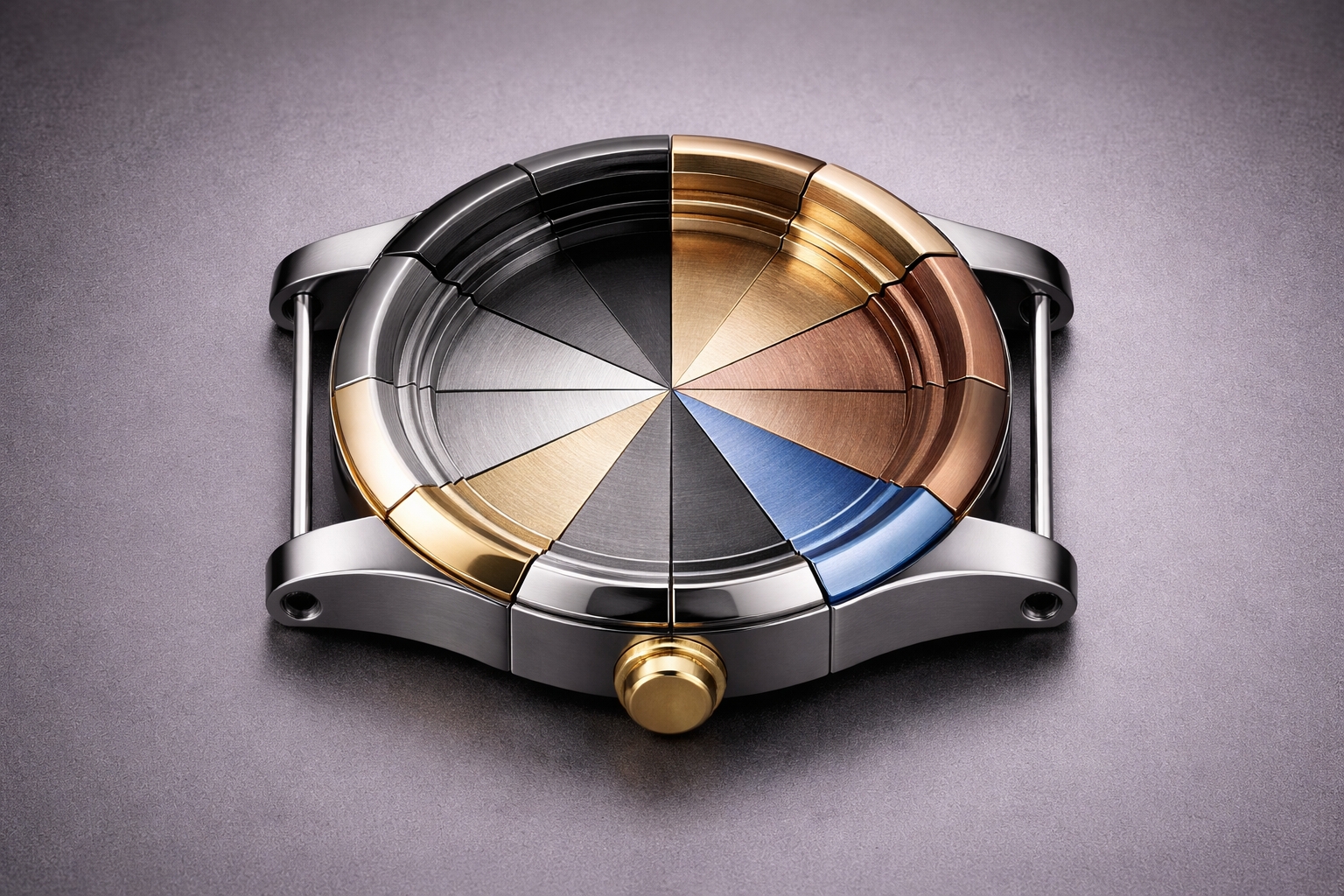
Yesterday, I wrote a post about black cases. There was a really cool AI generated “copyright free image of a somewhat generic PVD coated black wristwatch with a plain white background” (that’s not a totally terrible prompt, is it?). Can’t miss it. The image for this post is considerably less MS Paint, but still very obviously AI generated. This is a very high level thing that I don’t have any examples for on hand, and I didn’t want to steal someone else’s image. If I’m writing something about a particular watch or movement, I will use real images that I take.
Meanwhile, back at the lab… I want to touch a bit on other finishes that are out there, as it’s worth discussing. It comes up… Oh… Probably every third build so far. Can’t hurt to put something here for the readers among you.
Just to dovetail on the previous post, any of the other PVD finishes follow the same advice as the black colored ones. The caveat being, the closer the color gets to the underlying metal (which is almost always silver), the less the advice applies. A slightly darker colored finish than the plain silver stainless color probably wouldn’t be terrible. I saw one yesterday, in fact, that called itself “titanium coated” or something like that in a marketing wank cover for being a PVD coating and not actually titanium while trying to make you think it was titanium if you didn’t look too close.
It goes without saying, this applies to… Actually, I’m not really sure what they’re doing. I was going to say “painted”, but it could be a number of things in reality. The finish I’m thinking of is where they try to make a stainless steel case look like bronze with a patina. It’s pre-patina’d, because whatever it is on the surface of the stainless steel is NOT bronze, and will NOT patina. Never looks right. Maybe for a costume of some sort, but probably not something most people would want to wear regularly.
Once the scratches start to appear, PVD, DLC, and other coatings can’t feasibly be redone. Once it gets beat up a little, to make a PVD watch look good again, you have to remove the coating and just make it stainless. Hopefully, it comes out of all the little nooks and crannies (it probably won’t). Not really a restoration per se, but it will at least look better. I think with DLC, you’re probably kinda screwed. I’ve never attempted it personally, but I imagine it’s a major pain to get that off a watch case with it being so hard. With a scratched up watch sporting DLC, you probably just have a scratched up watch until you enter it into the permanent sock drawer collection or sell it.
To a lesser extent, this same logic applies to plating as well. It’s usually thicker than PVD. Gold plating is soft, and lower contrast, so scratches are somewhat less noticeable, but they will also eventually lose their color. Russian watches, for those of you into the vintage stuff, were most often chrome plated brass, and losing their chrome plating was called “brassing”. Looks terrible, and you need a friend with a hotrod shop if you want to get a case replated (too expensive, and too small for any plating shop to talk to you, but hang it off the end of a ’58 Coupe DeVille, and you’re in business!). There were certainly chrome plated brass watches that didn’t come from Russia, but that’s what I personally associate it with the most, coming from years of servicing and repairing vintage watches.
So, that’s the stuff to look out for. If you want a whatever-color watch, and it’s a PVD or paint or plating situation, that’s totally cool. I’ll build it for you just the way you want it. Just be aware of the ramifications of that decision.
The case finish I recommend most often is brushed stainless. If you get a scratch, it’s the same color, and with the brushed texture, you have to really get the light at the right angle to see all but the deepest of gouges in the wrong orientation. The orientation of the scratches relative to the brush grain can do a lot of work in terms of hiding things/blending in. Media blasted stainless is similar (I don’t think that’s the marketing term for it, but that’s how they do it), but the lack of grain doesn’t hide as well. Polished stainless gives you the same color inside and out, but the mirror finish makes scratches really stand out. Polished stainless really looks nice, it’s just that you have to re-polish it occasionally to keep it looking nice, and when you add a bracelet in there, which also needs to be at least partially polished to match, you have a lot of scratch potential.
I’m wearing a polished stainless chronograph as I type this. It’s nearly two years old, and gets worn almost daily. It hasn’t suffered any major abuse, but life just comes with a lot of scratches. There are plenty of little light scratches visible, but you have to look to see them. I use brushed stainless on what I call my “shop watches” that see the most abuse, and it’s surprising how little they show.
I said in the previous paragraph that I recommend brushed finishes the most, and that’s true, but has a lot to do with the watches being built and what’s available on the market to build them with. The finish I LIKE the most is a mix of brushed and polished. Done right, with the brushing and the polishing strategically located, you get the best of both worlds. The high end appearance of the polished case PLUS the contrast of the brushing is clearly an extra manufacturing step, and looks great. If the brushing is in the places that are most exposed to scratches, and the polishing in the places least exposed, you also get the scratch hiding longevity boost of the brushing. You see this on a lot of high end watches, Omega being the one that comes most immediately to mind where the case lugs are polished on the contours/slopes, and brushed on the tops and sides. I’m not sure it’s the most strategic place for a polished face, but it sure looks good!
With stainless, refinishing is an option. I can polish or rebrush a case pretty easily. I can do the blasted effect even easier (though, I don’t have the equipment to do so at present, and not sure I could justify the space or cost). I like the little subtle scratches, and consider them part of the life of the watch, which I understand is a fairly common way to think about it.
Leave a Reply