
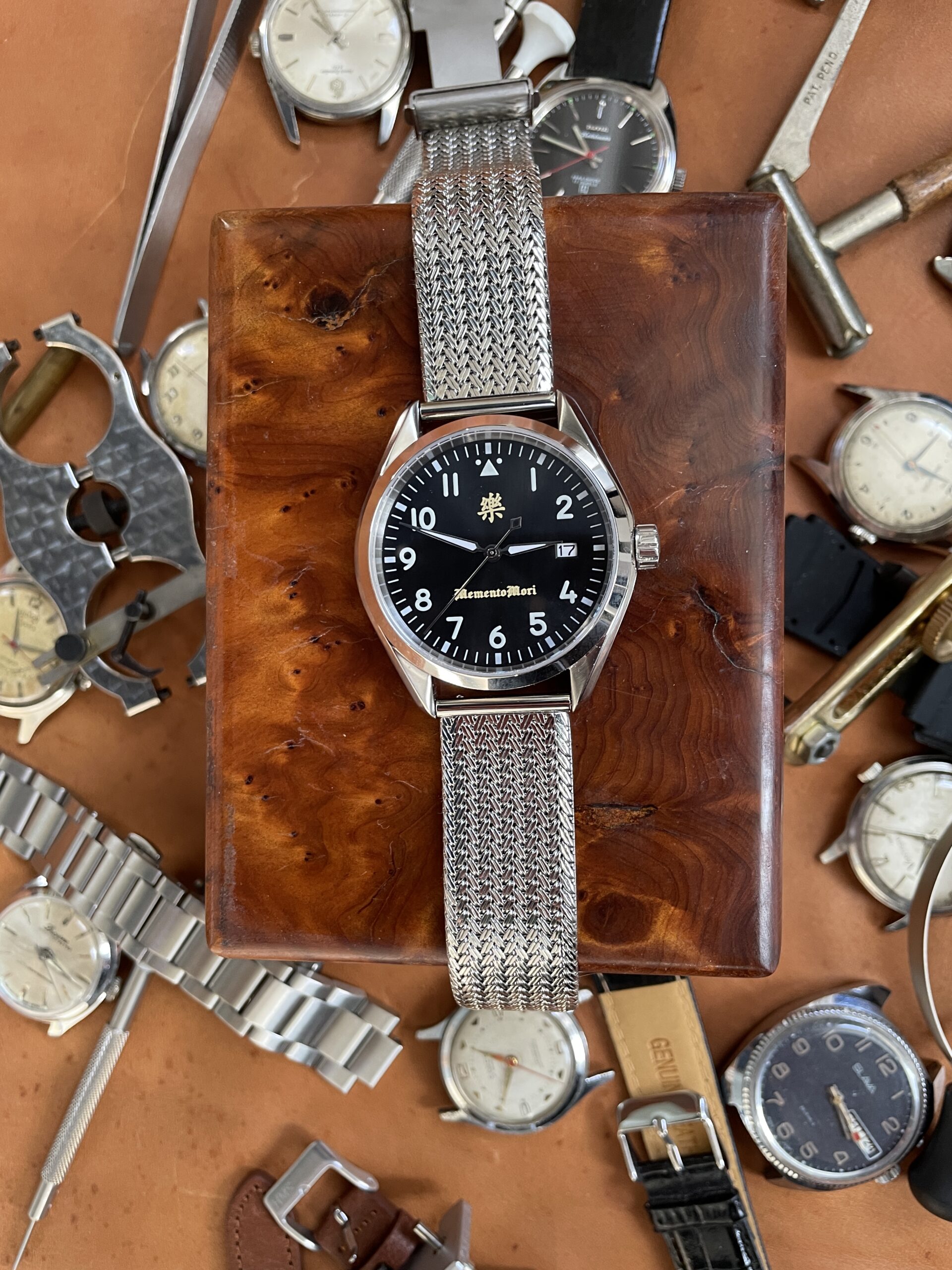
Right up front, Rocinante was Don Quixote’s horse. A workhorse that the delusional knight errant believed to be the greatest steed in all of history. Rocinante didn’t start out all that great, but became great (the parallel doesn’t exactly work in that particular aspect, to be honest, but we’ll come back to that momentarily). “Rocin” means “workhorse” and “ante” means “before”.
Additionally, I’m a sci-fi nerd to some extent. Not painfully so, but I’ll watch any space opera over every medical drama given the choice. My favorite sci-fi franchise is The Expanse. There’s no real tie in between watches and The Expanse or the sci-fi genre (though I do have a sci-fi themed watch planned for the near future!), it was just on my mind because I had been listening to the audiobook, and the print version was sitting on a shelf in the room where I was trying to come up with the name for this venture. Rocinante was the name of the protagonists’ ship, and with a similar meaning in mind.
The primary tie in, and primary focus is, of course, workhorses. I’m no farm boy. I grew up in a suburb of Dallas, and up here in this canyon is probably as rural as I’ve ever been. It’s a 15 minute drive to… Pretty much anything, but also pretty much everything. Denver is right there. I don’t know a thing about horses; work, race, dressage… that’s all the kinds I can come up with. They’re all the same distant out of focus concept to me. Nope. Workhorse movements.
If you’re into watches, and let’s face it, you’re reading this, so you almost certainly are. Otherwise… Why are you reading this? If you’re into watches, you’ve undoubtedly heard the term “workhorse movement”. I see it most often referring to the ETA 2824, but it gets applied to several others as well. That’s the focus.
See, there’s been this trend over the last decade and change toward in house movements. It’s not an easy thing to do. The watchmaking industry is an especially opaque one, but I would honestly be surprised if even the biggest and most comprehensive watchmaking enterprise were able to make an entire watch from scratch without bringing in some manner of external material or component. I’m quite sure, even today with the massive degree of consolidation in the industry since the quartz crisis, it hasn’t happened yet.
On top of that, there are manufacturers with “in house” movements, where they just put a branded rotor on an otherwise ebauche movement. Some do a little more, but they are still just slapping a sticker with a different name on top of another manufacturer’s name. I’m not alone in my distaste for this sort of thinking in the industry, and you’ll never see me do anything even vaguely in that direction.
Used to be, most watch manufacturers were really assemblers. They might have made some part or another, but mostly they contracted with specialists for the various parts. They brought in all the movements, cases, dials, hands, bands, etc. needed to make watches, and then assembled and regulated them. A lot… no, most really popular vintage brands worked this way. This is just how it had to be with a product so incredibly complicated, high tech, precise, etc. If you purchased the machinery and hired the personnel to make jewel bearings… That was it. Good luck being able to make anything else! It’s all just too capital intense.
Anyway… More on that another day, maybe. Point is, workhorse movements! These days, there aren’t as many as there used to be. Quartz crisis. (Thanks Seiko!) These movements are proven, reliable, accurate, AVAILABLE, and serviceable. Not all in the same way, exactly, but in some way (I’ll write another blog post talking about how the different modern workhorse movements are serviceable).
For a long time, ETA supplied pretty much the entire Swiss watch manufacturing industry with movements. Back in the early 2000s, they announced they weren’t going to do that any more. There were lawsuits, and it took a while, but today, it’s very difficult to get hands on an ETA movement or ETA parts. Pretty dick move.
The point appears to be to try to capture aftermarket service and the associated revenue. See, with all the movements out there, if watchmakers can’t get parts, owners have no choice but to send their watches to Swatch (the maker of craptastic plastic watches that are famously disposable) for repairs and service. Modern watches produced by the Swatch group often don’t even have documentation. I read up on a movement the other day that is regulated by lasers, and can not be regulated after the manufacture. In a watch selling for mid-four figures. WTF????
Here’s the thing: if you can’t get a watch serviced, it’s disposable. If the hoops you have to jump through are great enough, human nature is such that it just won’t be serviced. It’s just sock drawer art. Used to be, watches were these incredibly valuable things. Heirlooms. They were given as gifts for major life events. They were proudly displayed on mantels. In this new paradigm though, that’s dead. Add to that the artificially increasing prices, and the industry is clearly trying to kill itself in the name of short term profits. They’ve done their best to kill watchmaking and watchmakers, though time and the quartz crisis did a fine job of that in the latter case. A watchmaker that can’t get parts, can’t repair your watch at any price, so now you get to pay more, work harder, and wait longer for something that should be able to be done conveniently and inexpensively in every town.
Screw that. Workhorse movements and their parts are available in huge numbers. A watch built around a workhorse movement can deliver on the original premise. Any watchmaker in any town can get parts and keep one of these movements alive. Inexpensively, conveniently, and indefinitely. A hundred years from now, there will still be millions of these things kicking around unloved in sock drawers ready to be split for parts for watches that are loved. That’s what watches should be, and that’s what I’m here to make. That’s why “Rocinante Watches”.
Leave a Reply